
Rogue Alert
Don't let your customers be your monitoring.
By the time most teams discover a problem in production, it's already costing them — revenue, trust, or both. Rogue Alert continuously monitors uptime, performance, and third-party vendors across every site you run, then tells the right people the moment something breaks. For commerce teams, it watches orders and inventory too.
Built by an architect who's launched 20+ enterprise commerce sites and seen the same failures, time and again.
Want to See It in Action?
Get a live walkthrough and see exactly how Rogue Alert catches what your current tooling misses.
Prefer email? Reach us at intel@roguealert.com
One Platform, Not Five
Most teams running business-critical sites are stitching together a separate uptime monitor, a performance tool, an inventory dashboard, a vendor status aggregator, and a deploy notifier — each with its own subscription, its own login, its own learning curve, and its own integration to keep healthy.
Rogue Alert collapses them into a single platform built for the way teams that depend on uptime actually work — cutting tool sprawl, lowering total spend, and giving your team one place to look when something breaks. New signals and monitors land continuously, so the one platform you adopt today keeps getting deeper.
Why It Matters
Minutes, Not Hours
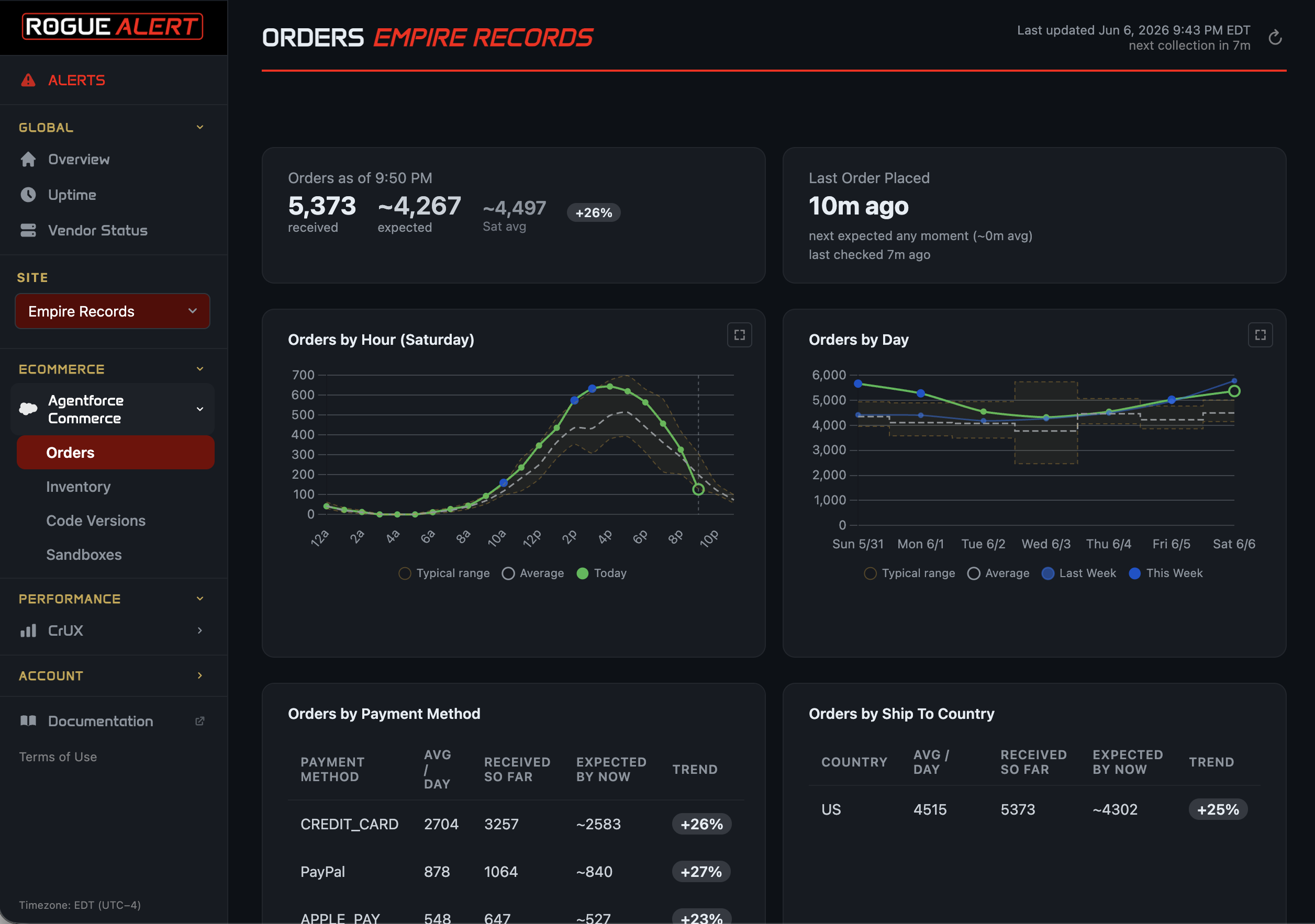
Rogue Alert builds a living baseline from your own traffic and order patterns — day of week, time of day — and keeps refining it. A quiet Sunday doesn't page anyone; a real order drop, silent checkout failure, or degraded vendor does. The longer it runs, the sharper it gets — so you get real problems in minutes, not a flood of false alarms hours later.One Pane for Every Brand
Multi-tenant by design. Run dozens of brands from a single dashboard with per-account access control — built for agencies and multi-brand operators, not retrofitted.Six-Figure Incidents, Avoided
Every hour an incident goes unnoticed compounds — lost revenue, breached SLAs, eroded trust, and a support queue that won't quit. Whether it's checkout failing or your site slowing to a crawl, Rogue Alert exists to cut that detection window from hours — sometimes days — to minutes.Nothing New to Install
Setup is a one-time, read-only connection to data you already produce — order APIs, uptime checks, vendor status. You grant access; nothing gets deployed. No new pixels on your site, no SDKs in your bundle, no schema changes, and no risk to the systems already keeping you in business.What It Watches
Uptime & Performance
Continuous uptime checks across every storefront, paired with real-world page-performance monitoring, keep you ahead of the slowdowns and outages that quietly erode conversion.
Vendors & Deploys
Status for the major third parties your site depends on — payments, tax, search, CDN — alongside your own deployments, so you can tell whose problem it is, fast.
Order Anomalies
Day-of-week-aware baselines catch order drops and spikes across multiple segments. When orders diverge from normal or stall entirely, you're alerted to silent checkout failures before support tickets arrive.
Inventory Intelligence
Per-variant sell-rate tracking surfaces stockouts before they happen and catches items that have gone unsellable on the storefront — giving you time to move inventory and prevent lost sales.
Alerts That Reach the Right Person
An alert no one sees isn't an alert. Rogue Alert reaches whoever needs to act on the channel they already live in, and routes by severity — so a critical incident escalates to a phone call while a minor blip stays a quiet message.
Email · Slack · Microsoft Teams · SMS · Voice Call · Per-Severity Routing
Wherever Uptime Is the Business
From storefronts to patient portals — anyone who can't afford a silent outage.
Commerce
Where Rogue Alert runs deepest. It reads Shopify and Salesforce Agentforce Commerce natively — order APIs, inventory, code versions, sandbox state — so every alert is one a merchandiser, developer, or ops lead can act on immediately.
Healthcare
Patient portals, scheduling, and telehealth where downtime isn't lost revenue — it's a care problem. Know the moment access degrades, not when patients start calling.
Financial Services
Banking, trading, and payment flows where time is money and a stalled page is a support storm. Catch latency and outages before your customers — and regulators — do.
Media & Publishing
Traffic is the business. For a media site, Rogue Alert flags the slow pages and downtime that cost you readers, ad revenue, and subscriptions — long before anyone files a ticket.
Travel & Hospitality
Booking engines, check-in, and reservation flows that can't stall at peak demand — exactly when every minute of downtime costs the most and trust is hardest to win back.
Everyone Else
If your site staying up is the business, you're covered. Rogue Alert watches uptime, vendors, and performance for any organization — learning what normal looks like, then telling you the moment something isn't.
Ready to See What You're Missing?
Book a demo and we'll walk you through exactly what Rogue Alert catches, and how fast you'd know. No new code, no risk to what's already running.
Questions first? Email intel@roguealert.com